On this page
We build Gushi, so read our entry with that in mind. We wrote the others the way we would want ours written: what each one is really good at first, then where it stops.
What changed with HSK 3.0
HSK 3.0 has nine levels in three bands instead of six, and the first regular HSK 3.0 exams are on 13 December 2026. The vocabulary roughly doubled to 11,000 words. For the first time the characters are split: 3,088 to read and a smaller set of 1,200 to write by hand. There is also a grammar syllabus, level by level.
That matters for apps. An app built on the old six levels can still be useful, but its lists no longer match the exam. Ask every app one question: does it follow the HSK 3.0 lists, all nine levels?
All the lists are on our HSK 3.0 hub, free and searchable. Each word list ends with a short quiz, so you can see where you stand.
The comparison at a glance
| App | Best for | HSK 3.0, all 9 levels | Cost |
|---|---|---|---|
| Gushi | Characters, words and the whole syllabus | Yes | One month free, then a subscription |
| Anki | Your own cards | Only with a shared deck | Free, paid on iPhone |
| Pleco | Looking things up | Word lists, not a course | Free, paid add-ons |
| Skritter | Writing by hand | Levels 1 to 3 so far | Subscription |
| Du Chinese | Reading short texts | Texts sorted by level | Free start, subscription |
| HelloChinese | Your first weeks | Levels 1 and 2 | Free start, subscription |
| Duolingo | Fun and habit | No | Free, optional subscription |
01Gushi Our appBest for characters and the whole HSK 3.0
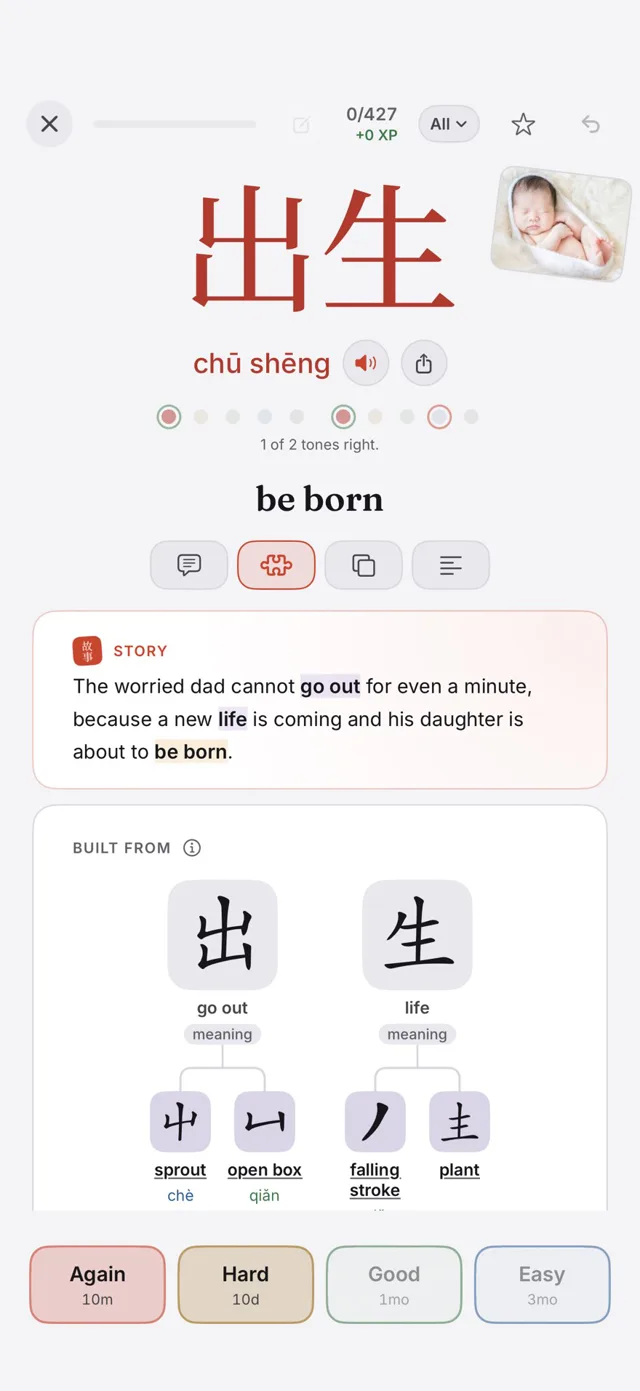
Gushi turns every Chinese character into a short story built from its real parts. 好 is a woman 女 with her child 子. Once you know the story, you know the character. Then FSRS, the same spaced repetition method Anki uses, brings each card back just before you would forget it.
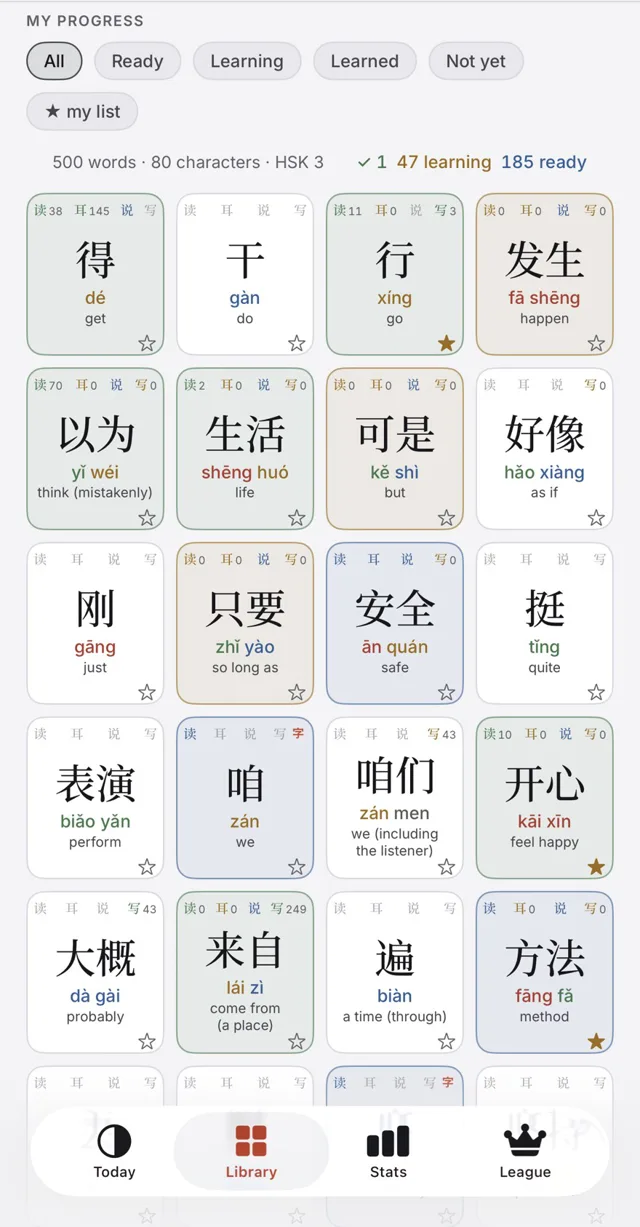
- The whole HSK 3.0: all 11,000 words, 3,088 characters and the grammar points, sorted by level.
- More than flashcards: reading, listening, grammar, shadowing for speaking, tracing for writing.
- Mock exams in the official HSK 3.0 format, level by level.
- Your textbook: if you learn in a class, Gushi follows ten common textbooks lesson by lesson.
- No deck to build. You open it and start.
Where it stopsThere is no live tutor and no conversation partner. Android is coming but not out yet; on other devices you learn in the browser.
CostOne month free, then a subscription. See the app.
02AnkiBest if you want to build your own cards
Anki is the gold standard of spaced repetition, and it is free on computer and Android. It can hold anything, and it does exactly what you tell it.
Where it stopsYou spend hours before the first card is right: finding a deck, checking it, fixing it. Many shared decks still follow the old HSK, though HSK 3.0 decks exist too. And plain flashcards get boring, which is why many people stop.
CostFree on computer and Android, a one-time purchase on iPhone.
03PlecoBest dictionary
Every Chinese learner should have Pleco. It is fast, works offline and lets you draw a character you cannot type.
Where it stopsIt is a dictionary first. A simple flashcard mode is free, the full flashcard system is a paid add-on, and there is no course or plan that takes you through a level.
CostThe dictionary is free, add-ons are paid.
04SkritterBest for handwriting
If you want to write characters by hand, Skritter is strong. It checks every stroke and its order.
Where it stopsHSK 3.0 asks you to write 1,200 characters, not all 3,088. Writing every character takes a lot of time for the part of the exam that needs it least. Skritter does little for reading and listening.
CostSubscription.
05Du ChineseBest for graded reading
Short texts sorted by level, with audio and a tap for every word. A good way to use what you have learned.
Where it stopsReading comes first. You can review the words you save, but nothing teaches you the characters and words of a level.
CostSome texts free, a subscription for the rest.
06HelloChineseBest for your first weeks
A friendly course with games and speech practice. Its newer course follows HSK 3.0 for levels 1 and 2.
Where it stopsA lesson tree sets your pace, not your memory. Under HSK 3.0 it stops after level 2.
CostFree start, subscription.
07DuolingoBest for fun, not for the exam
Duolingo makes a daily habit easy, and the streak and the leagues keep you coming back.
Where it stopsThe Chinese course is not sorted by HSK level. Good as a start, not as exam preparation.
CostFree, with an optional subscription.
Which apps to combine
- Starting from zero: Gushi for characters and words, Pleco as your dictionary. Add Du Chinese once you know about 300 characters.
- Preparing for an HSK exam: Gushi for the level and the mock exams, Pleco for looking things up.
- Learning in a class with a textbook: Gushi on your textbook's lessons, so you review exactly what your class did this week.
- You love to tinker: Anki and Pleco. Plan time to build and fix your decks.
- You want to write well: add Skritter, but only for the 1,200 characters you have to write.
Planning the year ahead? The best HSK 3.0 apps for 2027, level by level says which apps to use at HSK 1 to 3, 4 to 6 and 7 to 9, and how many new words a day each level takes.
How we chose
We asked every app the same question first: does it follow the HSK 3.0 lists, all nine levels? Then we looked at what it teaches (characters, words, grammar, the five skills of the exam), how it brings words back, and what it costs. We read each app's store page and used each one ourselves. Every number about the exam comes from the official HSK 3.0 syllabus, published in November 2025 by Chinese Testing International. We build Gushi, and we wrote its entry by the same rule as the others: what it does well, then where it stops.
Frequently asked questions
What is the best app for HSK 3.0?
For the characters and words of all nine levels, Gushi. Add Pleco as a dictionary and a reading app such as Du Chinese once you can read short texts.
Is Anki enough for the HSK?
Anki is good at helping you remember, but it only knows what is on your cards. The exam also tests listening, reading, writing, speaking and translation. And many shared Anki decks still follow the old HSK 2.0.
How many characters do I need for HSK 3.0?
3,088 to read for the highest levels, and 1,200 of them to write by hand. Each level's numbers are on the HSK 3.0 hub.
Are there free HSK 3.0 word lists?
Yes. All 11,000 words, 3,088 characters and 428 grammar points are free to download as CSV and JSON, no account needed.
Which app is best for learning Chinese characters?
An app that explains each character, not only shows it. Gushi gives every character a story from its parts. Skritter is best for writing them by hand.